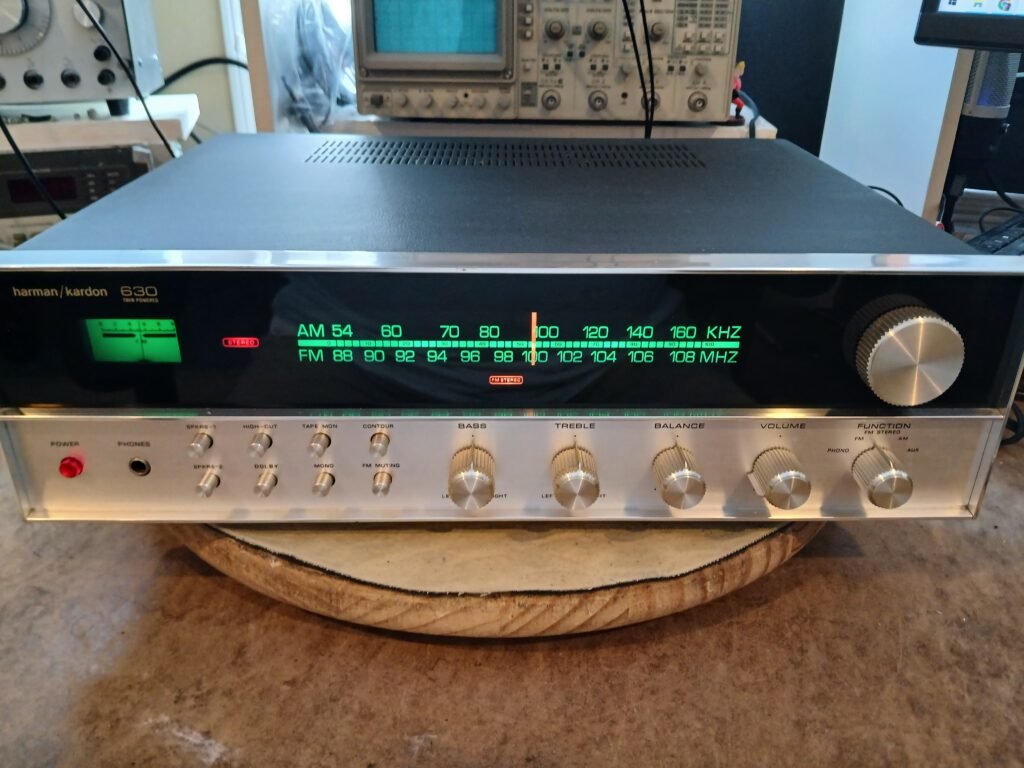
Harman Kardon HK630
$600
Examples of interior restoration results (click on photos to expand)
Exterior photos
Restoration notes
Beyond the list of standard restoration steps detailed on the main page, here are some added notes for this unit :
I got this receiver from a local collector. Exterior condition was very clean. There were some slight dings and a scratch on the top of the faceplate surface (see last exterior photo above).
What follows is some background on this reasonably rare receiver,
The hk630 was the first of the highly regarded line of “twin power” receivers from Harman Kardon. The hk930 was released soon after with the hk430 and hk730 coming ~2 years later. These all share the “dual mono” architectures with separate transformers, power supplies and main filter caps for the left and right channels (see interior photos). The hk330 (A, B and C) were also released in this timeframe, but those were not “twin power” receivers.
As the model numbering would suggest, the hk630 spec output power (30 watts per channel) sits between the more commonly seen hk430 (25 WPC) and the hk730 (45 WPC). The entire line of twin power Harman Kardon receivers are very well built, share similar architecture and performance reflecting their emphasis on accuracy beyond standard sine wave harmonic distortion (adding design goals to minimize phase error, square wave distortion and maximize damping factor).
Cosmetically, the hk630, hk930 differ from the hk430, hk70 by having nickel-coated trim frames on the faceplate (vs black on the hk430, hk730), FM center meters, AM on top of the dial (FM on bottom) and a cleaner metal case (vs the “fuzzy” surface on the hk430, hk730).
This hk630 example was originally sold in Europe and had already been properly modified (internal setting change) to operate in the US. The tech that did this chose to reuse the power cord and just replace the plug. Since Europe uses 220VAC, the outlet current draw is basically half what it is at 120VAC at the same operating power. This means they can use smaller gauge copper in the power cord. I decided to replace the power cord to get back to thicker copper wiring gauge normally seen on a unit like this operating at 120VAC.
I also noted that the previous tech had added a toggle switch in the back of the unit to allow the user to override the normal dial illumination behavior (dial lights off when not using AM or FM modes). Flipping this switch keeps the dial lit up whenever power is on. I verified that this mod was done correctly, and expect some will find this a handy added feature.
Physical inspection revealed that the rear RCA jacks for phono and aux were a rather loose. I was able to tighten these up significantly, though they are still a tad wiggly. This is not an electrical issue – these inputs will perform fine with RCA cables attached.
Initial testing showed a high level of functionality (FM, etc working well). It looked like someone had replaced the FM muting pot that is accessible through a small hole in the rear of the unit. Strangely, the shaft on the pot lacked the normal groove you would use to adjust it using a small standard screw driver, so I used a Dremel to carefully create cut a suitable groove.
The DC offset at the speaker outputs was ~100mV, so I replaced the main amplifier differential pair input transistors with highly matched equivalents to get these under 20mV for both channels. This also enabled setting the idle currents to spec levels.
I applied service bulletin #165 which basically reconfigured the low voltage supplies to match what was later made standard on the hk930. The fact this had yet to be done indicates to me that this receiver never needed major servicing as this mod was to be done whenever a unit was otherwise in the shop for repairs.
Recap and alignment were completed. Functional testing complete/passed. The FM section performs nicely and the amplifier sounds very much like the hk930 I restored earlier (ie very detailed and accurate).
Bench measurements
This receiver is specced at 30 watts per channel (both channel driving 8 ohms, 20Hz-20,000Hz, 0.5% THD)
My results at these same conditions was 35 watts per channel.
I checked at 50,000Hz and still saw over 32 watts per channel.
Square waves also looked very nice across this same range (as expected given Harman Kardon’s design emphasis on optimizing this) .
Some reference links
hifiengine : https://www.hifiengine.com/manual_library/harman-kardon/630.shtml
Classic Receivers : https://classicreceivers.com/harman-kardon-630