Yamaha CA1000 + CT800
$800
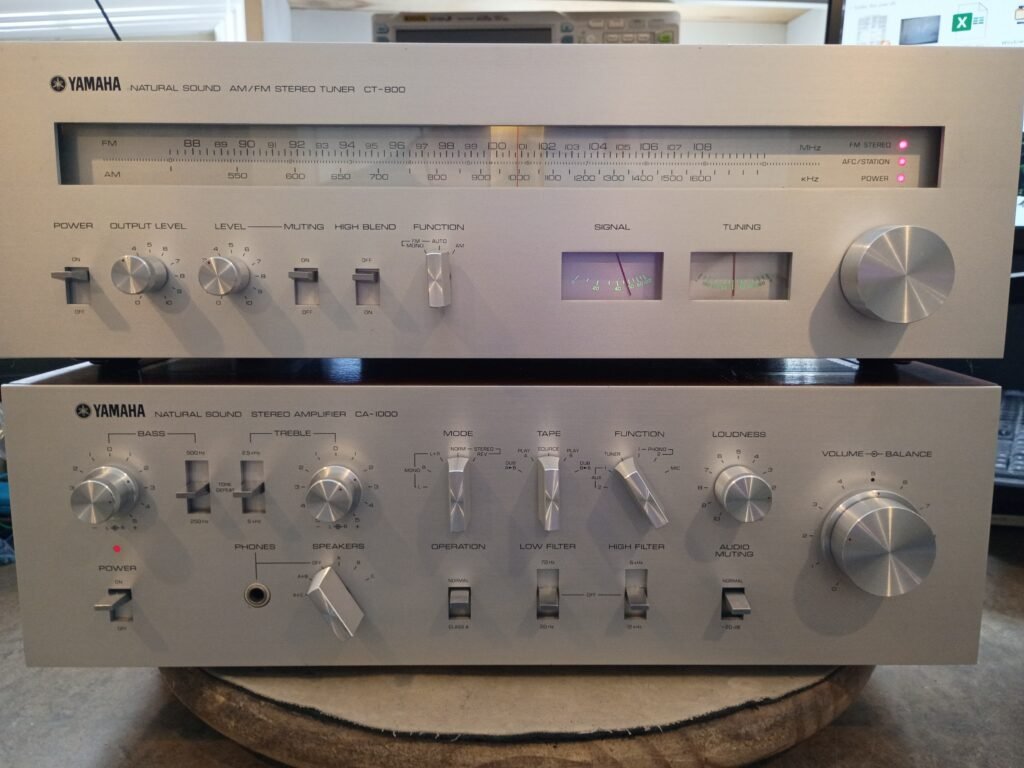
Examples of interior restoration results (click on photos to expand)
Exterior photos
Restoration notes
Beyond the list of standard restoration steps detailed on the main page, here are some added notes for this unit :
Yamaha CA1000
I bought the CA1000 from a pawn shop in Connecticut, so information on its functionality. The cosmetics were very good.
The CA1000 is an interesting integrated amplifier that is rated at a respectable 70 watts per channel operating in Class B mode (used by the vast majority of amps in this timeframe). It also has the unusual ability to switch to Class A operation at 15 watts per channel (plenty of power for efficient speakers). Class A operation offers a tradeoff of inherently lower distortion with substantially higher idle power and resulting heat (Class A idle current is ~20x higher than the Class B setting).
Note : It is highly recommended to only switch between Class A <=> Class B with the power turned off.
Initial power-up testing revealed that the +50V power supply was dead. I found an out-of-spec fuse resistor on the power supply board. Replacing that brought the +50V rail back to life. All other fuse resistors were checked – replacing any out of spec.
Cleaning dirty switches/potentiometers and replacing the protection relay cleared up noise issues. The recap went smoothly (other than the large main amplifier caps being a challenge to source). The Class A <=> Class B switch actuates 2 internal micro switches that change the transformer windings going to the +/- amplifier supplies. I replaced these with new/identical micro switches (nice that these are still being manufactured).
Given the quality of the CA1000, I decided to upgrade the original spring clip speaker terminals to the modern 5-way variety for all 3 speaker outputs. (see photos)
The CA1000 wood veneer cabinet has a few minor dings (see photos) while the faceplate and knobs are clean.
Functional testing complete/passed.
BTW – I ran Class A mode for ~2 hours and (as expected) the top of the amplifier got very warm. It is therefore especially important to keep the top cabinet vents unblocked when running Class A (even if it only idling without any audio and volume at minimum). While I usually put the tuner on top of the integrated amp, I recommend switching that (amp on top) if you plan to use Class A mode.
Yamaha CT800
I bought the CT800 on ebay after researching the best companion tuner for the CA1000. Yamaha did not make a “CT1000” which made the CT800 the best option. It had a broken output level control, but was otherwise in good shape. On getting it delivered, I noted that the cabinet wood tone differs vs the CA1000. I am highlighting this as it is not ideal, but IMHO this is acceptable as they look well matched from the front.
Initial inspection showed that 2 of the internal transformer secondary 300mA fuses were blown. I replaced these and looked for anything that could have caused this. I probed the power supply outputs and was confused that 2 rails related to the blown fuses had reversed magnitudes (+28V, +30V swapped). Digging deeper, I saw that the my version of the power supply board was different than the service manual – specifically that I had a slightly modified power supply PCB. For some reason, Yamaha switched the board traces to these 2 voltage outputs, but did not update the board output labeling nor the way the outputs were wired to other boards. I triple-checked what I was seeing as the factory usually “does it right” even when the board labeling is wrong. I switched the wiring to match the schematics, and have had no issues with those fuses after many hours of testing. I think the factory miswiring led to an eventual over-current issue that blew those 300mA fuses.
Recap went smoothly and I installed a replacement output level control which works fine. The available Yamaha part has a mechanical “detent” in 10 positions while the original lacked this. You can stop between the detent points for finer adjustments. This is another “not perfect – but not a big deal” issue I wanted to point out. Again, the electrical performance is fine.
Note that contemporary Yamaha receivers coupled FM muting to FM stereo mode. The FM muting threshold level could not be adjusted (even by a tech). This was unpopular as weak FM stations that could still deliver stereo would be muted, The user would have to listen to them in FM mono mode (FM muting off).
This tuner allows fully independent selection of FM <=> FM stereo vs FM muting off <=> on (FM muting level setting by the user). It is also sounds quite good.
Similar to the CA1000, the faceplate and knobs are clean while the cabinet has some minor dings.
Bench measurements
The Yamaha spec covers both Class A and Class B operating modes. Power ratings are with both channels driving 8 ohms from 20 to 20,000 Hz.
Class B : 70 watts per channel (0.1% total harmonic distortion)
Class A : 15 watts per channel (0.1% total harmonic distortion)
My results :
Class B : 84 watts per channel (0.5% total harmonic distortion) *
Class A : 18 watts per channel (0.5% total harmonic distortion) *
* note that my equipment can’t accurately measure distortion lower than 0.5%
At the power levels shown I saw zero clipping on the oscilloscope, so <0.5% quite likely.
Some reference links
CA1000
hifiengine : https://www.hifiengine.com/manual_library/yamaha/ca-1000.shtml
audio database : https://audio-database.com/YAMAHA/amp/ca-1000.html#google_vignette
CT800
hifiengine : https://www.hifiengine.com/manual_library/yamaha/ct-800.shtml
tuner info center : https://www.fmtunerinfo.com/yamaha.html