
Marantz 2010
$400
Examples of interior restoration results (click on photos to expand)
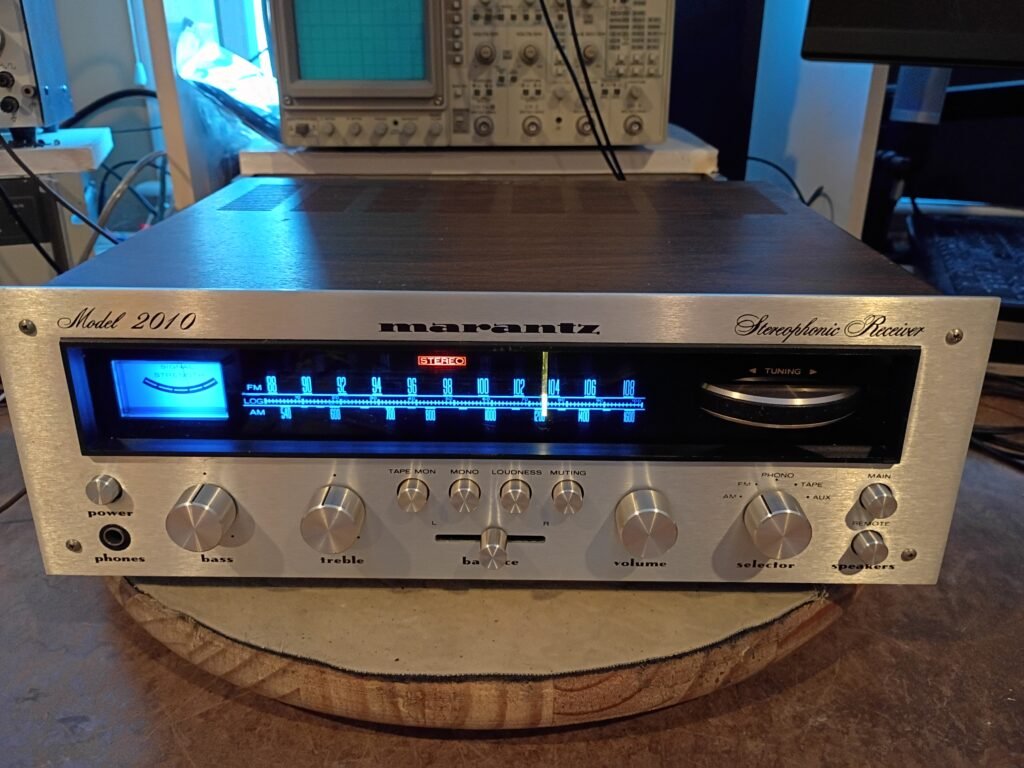
Exterior photos
Restoration notes
Beyond the list of standard restoration steps detailed on the main page, here are some added notes for this unit :
I acquired this receiver from the original owner and was told it recently stopped working. Cosmetics were very good.
The 2010 is the “baby Marantz” first sold in 1972. Though very compact (~14 inches wide) it has same high regarded electronics and build quality as the larger members of the early 1970s Marantz receiver family. While only rated at 10 watts per channel, the 2010 can easily drive efficient speakers to very high decibel levels in smaller spaces (workshop, den, etc) . Many rate the 2010 (and the later 2015) among the best sounding Marantz receivers due to its simple/clean amplifier design. Some examples of this:
Skylabs : https://www.youtube.com/watch?v=F_HBsJ6pxNw
Gear Patrol : https://www.gearpatrol.com/audio/vintage-marantz-receiver-buying-guide/#product-marantz-2010
These are fairly rare. Apparently Marantz cut back on 2010 production as they were cannibalizing sales of the more expensive receivers like the 2215 and 2230.
Initial inspection showed some issues :
No feet (new ones installed)
Typical greenish dial due to yellowed vellum (new vellum installed with cold white LEDs to get the right blue color back)
Dial pointer slipping (very typical for old Marantz receivers, new string installed)
Vented (ie failed) electrolytic capacitor in power supply (recapped power supply before applying power)
Initial functional testing had to be paused to clean the selector contacts which made the receiver spring to life with everything working (though the sound was not great).
Something to note is that the “stereo” light comes on whenever using phono, aux or tape input modes. When selecting AM, it is off. When choosing FM, it comes on when tuned to a FM station it can receive in stereo. There is a “Tape” position on the selector which is really just a 2nd Aux input. This is in addition to the tape in/out RCA jacks (with tape monitor mode) – which means there are 3 Aux level inputs for CD players, etc.
Recap went smoothly with the sound notably improving when the main amplifier was completed (including installing new Nichicon GoldTune output capacitors). The FM tuner sensitivity is “fair” and sounds very good on stronger stations.
Final functional testing complete/passed.
Cosmetics are very good. The faceplate is clean with the “M” in FM being partially rubbed off at the selector knob. The 4 large knobs have some light scratches if you look really closely. The cabinet (vinyl wood grain over steel) only has minor dings on the bottom on the sides. Overall a very good example.
Bench measurements
The Marantz spec for the 2010 amplifier is typical for 1972. It states 10 watts per channel with both channels driving 8 ohms with distortion under 1%. There is NO mention of the frequency range for this spec, so I will assume this was at 1000 Hz (typical spec point back then)
My results : I always test from 20 to 20,000 Hz (both channels driving 8 ohms) and saw the very typical roll off on power under ~100 Hz with 1% max distortion
100 – 20,000 Hz : 12 watts per channel (20% over spec at 1000 Hz)
20 – 20,000 Hz : 8.5 watts per channel
Repeating that this is plenty of power if paired with efficient speakers in a smaller room.
Some reference links
hifiengine : https://www.hifiengine.com/manual_library/marantz/2010.shtml
Classic Receivers : https://classicreceivers.com/marantz-2010